Tuesday, March 22, 2016

"Hello and Hola!": Implementation of Dual Language Education into the Elementary Classroom.

Studies Prove that Bilingual or Dual Language Learning Improve English Language Learners' Capacity to Learn English.

 Currently there are 5.3 million students in the American school system that are ELL. The question is how should we teach them? In my previous post, I discussed Bilingual--also called Dual Language--Education. DL Education offers both ELL and Native speaking students(NES) offers students the chance to learn their content through a partner(Spanish) and English language.  DLE varies on instruction, being divided into two methods: 90:10 and 50:50 method. Within the 90:10 model the majority of the class is spoken in Spanish with the remaining in English, while 50:50 splits the two evenly. There have been studies demonstrating benefits of DLE for ELL and NES in the classroom, in hopes implementation nation wide. Regina Cortina, Carmina Makar and Mary Mount-Cors confirm research in a Manhattan school that "ELL students enrolled in DL programs were academically ahead of those in English-only programs...their dropout rate was lower in th[e]se programs compared [to] English-only programs"(Cortina, et.al). With the promotion of DLE Kathryn Lindholm-Leary writes in her article "Success and Challenges in Dual Language Education" about challenges occurring from DLE and debunking them, showing the importance of DL classrooms. There is a clear success within DLE, if properly executed. She goes over five main challenges that persist in DLE when poorly executed, offering research that debunk claimed  "problems". People see  the amount of English exposure to ELL students as a problem, believing that the more exposure students have to English, the higher their understanding. However,the amount of English does not determine students' success but rather, the quality of the material presented.Students placed in 90:10 classrooms which speak very little English, exhibit same levels of proficiency in their core subjects the same if not higher, than students in 50:50 classrooms. A study that proves this comes from Margaret Bridges and Sara McElmurry article titled "Buenos días! Good Morning!", where curriculum is taught 80% in Spanish and the remaining in English. This classroom increases proficiency in both languages to ELL and NES children, while encouraging cross cultural understanding. Although the children learn predominantly in Spanish until the fourth grade, their scores "show promise: ELL's are outperforming those in transitional bilingual programs, and NES test higher than peers in traditional classrooms"(Bridges and McElmurry). It promotes learning in both languages, no matter the language being spoken, showing improvement in English through assessment.

Ms. Griselda, reading to her kindergarten students in English. Predominantly 80% of the class instruction is taught in Spanish.
There are also "accountability challenges" concerning assessing student progress and demonstrating students' grade-level reading skills in partner and native languages. Studies found achievement on track if not higher than traditional classroom and,correlate English proficiency through proficiency in reading their partner languages(Lindholm-Leary).  Challenges also arise in the development of oral language and proficient bilingual skills. Research proves "language and literacy skills in primary language play an important role in second language and on skills appear[ing] to transfer one language to another on instructional approaches that  benefit promoting literacy in a second language"(Lindholm-Leary). DLE offers numerous approaches to promote bilingualism through constant switching of English and Spanish. Within Margartet Bridges article, teachers found strong correlations between DL classrooms with bilingualism, "offer[ing] children chances to maintain--and gain literacy in--their home language while becom[ing] fluent in English and succeed[ing] in classrooms"(Bridges, et.al). They have opportunities to learn English, while maintaining their ethnic roots. Cortina writes similarly in her article stating that ELL students demonstrate pride when speaking their native language in school saying: "they speak it [and] become proud of it...they are happy and proud to be in a school called DL...because they feel we're giving them something that they were losing"(Cortina, et.al). In DL, the promotion of bilingualism allows students to communicate beyond the traditional language mandated by America. With the provided research presented concerning DL instruction, educators believe it could change the way students are instructed. Will this success spread like wild fire, or will students miss a once in a lifetime opportunity to communicate with mass populations?

Developing Language Skills For Educating English Language Learners


        Through the research articles I have read I really have decided to look deeper into the concept of developing English Language Learner’s literacy development. This is a very prominent topic with both academic and general audience because of all the many foreigners coming to America. In fact the article “Effective Strategies for Improving Writing Skills of Elementary English Language Learners” states that, “Demographers predict that in twenty years, the ratio of English learners in the student population could be one and four” (Cole, Feng 3). Through researching more about the linguistics aspect I have begun to understand language skills are going to influence the education these ELL students need.

When focusing of the English Language Learners Literacy development one needs to consider the environment in which this literacy learning is being taught. In the article “Mainstreaming English Language Learners: Does It Promote or HinderLiteracy Development” looks at a study of two fifth grade students that are English Learners. In this article it states that” The study explored their classroom activities with the expectation of unraveling the difficulties faced by immigrant students in developing literacy in English as a second language” (Guiebre 33). The findings suggested that the students were lacking content knowledge (Guiebre 35). There was a divide in the classroom when it came to fluency. Both of the students were taken out of there mainstreamed class during a subject and then would return back into the class in the middle of another subject. This article also shared that “the higher their fluency, the more interaction there was with the teacher” (Guiebre 37).  Over all it comes down to their language skills; after reading this article it seems to me that the more developed their language and literacy abilities are they will perform better in the classroom as a whole.

The article “Building Vocabulary for Language Learning: Approach for ESL Learnersto study new vocabulary” focuses on the best approach to educating these students. The article right off the bat states that “language learners need to master both spoken and written forms of vocabulary and distinguish its meaning to craft successful meaningful connections socially and mentally” (Alharbi 501).  Although the article does suggest read–aloud, word cards, word walls and list group label for beginners; it also says there is more to it. It is suggested by this article that when learning new words mental and cognitive strategies are important.  It is stressed that students should “understand the basic meaning, categorize them, and put them in groups” (Albarbi 503).  Based on studies the technique they recommend consist of building on synonyms, learning definitions with context, listening and punctuation process , book mark word search, and remember strategies for writing. These techniques are a progressive method to develop ELL’s vocabulary that are encouraged to be started at an early age.

To build off of the vocabulary and expanding the language development for ELL students it is important to focus on writing aspects of their language usage as well. The article “Effective Strategies forImproving Writing Skills of Elementary EnglishLanguage Learners” emphasizes the importance of essential writing and language skills especially as our world has become so text- dependent and oriented. Therefore, writing is such a dominant factor in comprehending a language. The article suggest “that the use of technology, pre taught vocabulary, various teachers influences and the implementation of positive diverse literacy practices…” (Cole, Feng 2) can help to create the best language learning out come for ELL’s. This article feels for the ELL student and validates that “ their vocabulary is often limited … they can communicate orally and be understood through gestures ,… writing proves to be frustrating for them as they attempt to express their ideas without the luxury of  using their hands (Cole, Feng 4).  The article expresses the importance of creating a conductive and comfortable environment. The article refers to this as “Fluency First Approach”; helping the students to get used to using the new language in context without being put down by grammatical errors. Then teachers take it a step further by “shar[ing] their experience, discuss students thoughts, and request additional information as feedback” (7); these methods help to prompt the students to want to write and use the language.  Teachers then need to prepare the students to write properly. The article encourages teachers to activate prior knowledge, and preview vocabulary by giving both definitional and contextual information about keywords. (Cole, Feng 8) Then the teachers have to scaffold and build on the student’s strengths. Once these students acquire these skills they can use resources such as technology and journals to further their skills. I look forward to using these skills one day and learning more approaches to educating English Language Learners in early education.

http://taylorfisk-ell.weebly.com/uploads/2/6/5/0/26503813/18336.jpg
This pictures represents the some English Language Learners a teacher could encounter in their class


Are Teenagers Ruining the English Language? From Social Scenes to Scholarly Sources

There is a mass presence of slang and improper language being used in the English language today. The major outlets for this to occur are through popular music, social media, movies, and texting. The group that receives most of the blame for these annoying slang words is teenagers; however, this solo blame is not always accurate.
The accusation placed on teenagers of “ruining the English Language” is exaggerated especially in social conversations. The language that emanates from the mouths and texting fingers of teens results from different forms of media such as movies, music, social media, and texting abbreviations. However, as supported by the article, “Point Counter-Point: Is the use of slang corrupting language?” written by Karalee Manis and Amanda Bagnall-Newman, teenagers are the ones that are most susceptible of this de-evolution of the English language because they are the most engaged in media.
Through media, people can see words and abbreviations being used such as “LOL,” “bae,” “omg,” and other acronyms. The article written by Karalee Manis and Amanda Bagnall-Newman uses the example of hearing people say, “they ‘can’t even,’ with that being the entire thought, and my eye twitches a little bit because that doesn’t even make sense. You ‘can’t even’ what? Finish a thought? What are you even saying!?” This empty statement results mostly from the mouths of teens because they are the ones that are divulged in media the most. However, according to Lafrance’s article in The Atlantic, “How much a person’s vernacular changes over time may have as much to do with personality and social standing as it has to do with age. The extent to which teenagers are credited with (or blamed for) driving lasting change to language is ‘grossly overstated.’” The blame that is placed on teens that is usually in social conversation is actually proved inaccurate by scholarly sources such as this article.
In addition, the people that are representing teenagers such as the creators of the music that they listen to are not teens themselves. Therefore, the ones that are using the slang language that is tainting the English language as we know it are not actual teens themselves. In an article in The Guardian written by Michael Rosen, he discusses his study of researching artists in movies, television, and music that bring slang into the media. He explains, “E4 youth drama Skins has squeezed more street talk onto screen than any of the soaps to date. Laura Hunter is one of its scriptwriters, which means not only writing the drama but also responding on Twitter in-role as one of the show's characters.” Laura Hunter is in her thirties, which solidifies the argument that teens are not the only ones responsible for bringing slang and improper English into everyday language.
In closing, even though society blames teens for “ruining the English language,” they are not the only ones using this annoying vocabulary, nor are all teens using improper grammar and language. 

Dyslexia vs. Society


Image result for communicationAlthough dyslexia is a known disability, which affects many school-aged children with the handicap to mispronounce or misspell common age and grade level words, many people do not realize the outcome of societal pressures the dyslexic student must face. These pressures faced in society to be accepted by a peer group is challenging for any child, yet the student with dyslexia faces other obstacles which can ultimately damage their self-esteem.

 During the pre-school years, generally children find acceptance among their peers and they begin to socialize. However, the stigma of “keeping” up with peers is a dreaded term for a child with a reading disorder. Not being able to spell, read or write causes these innocent pre-school children to turn against each other. 

Children begin to notice by middle school that certain students just can’t “keep” up with simple directions or these "certain students" may mispronounce words, which in turn causes the dyslexic student to become alienated in an already hormonal world. Dyslexia affects academics and learning but also affects emotional well-being. Research also suggests that these feelings of inferiority develop by the age of ten. Peers begin to notice that there is “something” wrong with their once beloved playground buddy, and the child who suffers from basic reading and writing skills begins to get pushed off into the shadows - only to watch their peers fluently read in class. The dyslexic can be often seen in the classroom shrinking down in their seats and avoiding eye contact whenever the teacher wants volunteers to read a passage aloud. Dyslexia can affect a child’s social life. They feel inferior to their boisterous peers who are always able to fluently finish a writing piece. Struggling in school can make child feel inferior around other kids. They begin to turn away from schoolwork and alienate themselves from the very material which is supposed to prepare "all" children for success in life. 

Children with dyslexia may stop trying to make new friends or may avoid group activities because a child with dyslexia often does not understand social cues or multi-step directions; and other students don’t want to be weighed down by someone who can’t keep up with the group. The dyslexic child may also have trouble understanding jokes or sarcasm; nonetheless, the lack of joking with your friends or not being able to understand joking demeanor is fearful while among a group of pre-teens. Adults can help a child decode humor and also try different strategies to improve self-esteem, but dyslexia can be difficult to spot in crowded classrooms or misunderstood as reluctant learning. 


Image result for communication Introducing a dyslexia student toward understanding language will help them be accepted among peers who share the same ethnography of communication. Assisting the struggling reader with different linguistic avenues to help them express themselves will empower them to feel involved and included with students of their own age, and overall, improve their self-esteem. This in turn will help the dyslexic child feel successful during their teen life, and all the way through adulthood. Introduction to rules of spelling - orthography - lexile level reading supplements, reader's theater workshops - where oral expression supersedes the written word, and other essential tools to aid the student to embrace their ethnography of communication and help them understand the challenging world before them.


Monday, March 21, 2016

Successful Dual Language Programs

Imagine moving to a new country with new peers and teachers, while trying to learn a different language, but your new school does not know how to properly educate you. This is a problem millions of ELL student's face every day while attending school. ELL students struggle to learn in regular general education classrooms, but they seem to be excelling in dual language programs. Dual language programs are unique because they mainstream the ELL students' primary language, while developing a new language.

According to Josie Izquierdo of ABC 7, "Spanish speaking students need both languages integrated in the classroom focusing on content, language, and language development." Researchers at Stanford University found students learn better when they learn in both languages. Using both languages makes it easier for students to make the transition from their native language to their new language. This ideology makes it easier for both the students and teachers by incorporating the new language when necessary and slowly building the usage in which they use the new language in the classroom. With this idea being implemented in school districts, the students will start learn the English Language and eventually the teachers will be able to phase out the students’ native language. This process may take a long time, but it will benefit both the students and teachers in the long run.

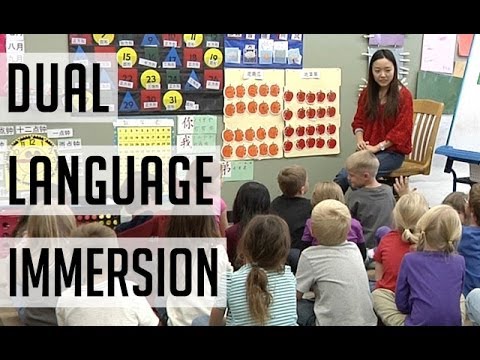
A dual language teacher instructing her class

District 112, an elementary school in Chicago, has successfully run a program similar to Izquierdo’s approach for twenty years. In 2012, 87 percent of their ELL students have met or exceeded the ISAT standards compared to 33 to 48 percent of ELL students outside of District 112. When the students are in kindergarten, they speak Spanish for 80 percent of the instructions and English for 20 percent of the instructions. By third grade, these same students will speak Spanish for 55 percent of the instruction and English for 45 percent of the instruction time; and by fifth grade, the students speak Spanish for 40 percent of the instruction and English for 60 percent of the instruction time. Once the students reach middle school, they can either continue in their same program or attend a different middle school, where they will be placed in general education classrooms. This program takes the students through their entire elementary school tenure, but by the time they are twelve years old, they are fluent in English. At the end of the program, the students are still very young and have only completed half of their public school tenure. They have approximately seven years left of school, spoken strictly in English and since they will be exposed to the language more, it will further progress their proficiency.

Not only can dual language programs assimilate the student’s native language into the classroom, but they can also integrate the student’s culture. Rachel Hazelton sees an obvious correlation between the student’s cultural background and their school performance. If there is no connection between the student’s home life and what they are learning in school, then they are less likely to apply themselves both in and out of the classroom. If the students’ interests are incorporated into the classroom, then students are more likely to apply themselves in the classroom.


"I Can't Even": Slang and the OED

The use of slang words in today’s society is a fascinating area of language to study because it is so prominent in popular culture. People are either repulsed by it or embrace it as a new way to express themselves and also as a way to create new language. Many of the slang words we use today have been around for decades but with the growth of social media and the increasing recognition of pop culture, it seems like slang is more commonly used today. It is interesting to see the expansion of slang in our dialects, in marketing, and even on television. But perhaps the most shocking involvement of slang is its inclusion in one of our most prestigious books: the OED. Since slang spreads like wildfire through the Internet and social media, its no wonder that the OED needs to keep up with the times. Words liked amazeballs and butthurt have been added to Oxford’s online dictionary, which has writers like Myf Warhurst in a tizzy. She believes that the OED has “lost its plot” and the world of words is controlled by 12-year-old girls. However it is these new words that prove that language is still alive.

In addition to new slang words being added to the OED, popular acronyms have made their debut as well. Writer Susannah Butter of The Guardian explores the addition of these abbreviations in the OED and quotes Graeme Diamond, principal editor of the OED as stating that the use of these text abbreviations are “are associated with young people, informality and are often used to show irony”. But in today’s society that statement no longer holds water. Slang and acronyms are used by many different age groups and its acceptance seems to be more widespread then ever before.

In today’s society, so many new behaviors are being invented and we need only make up a catchy term to go along with it, post it on social media, and BAM! we have a new slang word. It is the communicative technology that spreads new terminology and social media has increased the process of making new terms popular. It seems that if a word makes it into the OED it is here to stay.

Even though terms have been around for years, it takes a certain event or slippage of the new word that makes its popularity grow. Boya Dee, another writer for The Guardian states that: “there will always be certain words that stay underground because of their niche use. But it only takes a very popular global icon like Miley Cyrus to get involved in twerking and ensure a term that has been around for years gets certified by the good folk at the OED”.


    Illustration courtesy of Buiness2Comumunity.com 
Overall, language can be looked at as a metaphorical ocean, constantly changing and ebbing. It is when we can appreciate language’s ever-altering tendencies that we can see how language reflects society and that it only enriches our culture.  If the OED is willing to adapt to the changes in language, then people should be more open minded to the popularity of slang words in culture.


Use of Sign Language & Spoken Language for Nonverbal Autistic Children

                Using sign language and spoken language when teaching language to nonverbal autistic students has proven to have a positive influence on verbal communication. Through research by Dr. Stephen M. Edelson, it was found that the area of the brain involved in speech production is receiving stimulation from two sources, signing and speaking, rather than just stimulation from one source, signing or speaking. The Wernicke area of the brain is responsible for both learning sign language and understanding spoken language. Thus, using sign language and spoken language proves to be more beneficial when trying to teach a nonverbal child language, rather than using only sign language or only spoken language.
                Visual supports are a necessity when teaching language to help acquire meaning to words. Some children with autism have difficulties with the auditory processing system which makes it more difficult to attach meanings to sounds. Signing and using pictures are a great way for children to try and produce sounds and make connections.  When I volunteered my time in a preschool disabled class (all autistic children though), there were two students who were nonverbal. These students were three years old, turning four, and neither of them had spoken one word. They made some sounds, but not many. Through the use of sign language, other visual aids (Picture Exchange Communication System; PECS), and spoken language, one of the students became verbal.  Today, this child, who I often babysit, does not stop talking. This is just one success story of how using sign language and spoken language does in fact help facilitate verbal communication. The other student never did acquire as much language as the other student. However, he did learn some words but mainly communicates through sign language or his PECS. The ability to become verbal all depends on the individual’s severity of the autism and the family and school supports that are offered to them.
                Sign language allows the children to have the abilities to learn the meanings of words, relationships, and other concepts. This will set up a mode of communication for their family and friends. The nonverbal children will be able to see that they are able to communicate their messages to the people around them, which will make them want to communicate more and be more interested in doing so.  The power of sign language allows these children to share meaningful events, build relationships, and come to a mutual understanding of each other through the language being used.

                Since I gained experience working with children with autism since my early teenage years, it has drawn me in and I became more interested in the topic.  I took two sign language classes in high school so I would be able to communicate with the nonverbal people I came upon in my field and in life itself. I always think back to how I was one of the people involved in helping a nonverbal child acquire verbal language. I was babysitting him the day he said his first two words clearly, “chip, please”. His mother cried hysterically when I called her and said that her nonverbal, baby boy with autism, spoke his first words. I have seen firsthand how the use of sign language and spoken language can help a nonverbal child with autism acquire language, and it is absolutely incredible. 

Teacher is reading a book and also teaching sign language to students.
http://media.mlive.com/newsnow_impact/photo/baby-sign1jpg-958c8d084e600b3b.jpg 

Saturday, March 19, 2016

Learning To Read Among English Language Learners

Since learning how to read is something that is critical to a child's success later on in life, it's talked about a lot on how to improve learning especially for children whose native language is not English. It is a common myth that people believe that if your first language isn't English that you won't be able to not only read well, but be able to read quickly. The problem I feel with this is that those children are hearing from parent's and anyone in general who believes in that myth and they automatically assume that they don't have the capability to learn the same as their other classmates. The importance is being able to inform the children and instruct them that they have the capability to learn how to read the same as anyone else.

Something interesting that people have found recently is that basic speed reading skills can be largely beneficial in developing one's language capabilities and helps out with their cognitive skills. Even though the non-native English reader will still be slower than those in the class, that slow speed will still be faster than a child's initial approach to learning to read. I feel that this will help children to gain confidence in themselves, which is a key element in learning.

I think the tricky thing for children are that at home their parents aren't speaking English so they are around that language a majority of the time and when they go to school they only are experiencing a few hours a day of English. Something people are bringing attention to now are dual-language schools. Even though these could potentially benefit the children being around teachers and other student's in the same boat as them, it also is limiting them. This will make them feel like outsiders and that they can't be in the same school as others. I think dual-language schools would help children if they attended and then switched over to a regular public school. It has been proven that this helps to build up the children's confidence and one of the children who attended the dual-language school that they interviewed had reported feeling smarter at this type of school due to the fact that they were able to get even instruction of both languages.

As most things it's better to get a head start on instruction, especially for the kindergarten age group. Children need to be able to master reading skills early on and this is something that deals with their home situation. If parents aren't teaching them at home and just assume that everything is done at school these children will fall behind. It has been shown that about 25% of children who don't master reading skills during school will have a tough time down the road. Which is why figuring out a solution for non-native English learners to learn reading skills is extremely important at the moment.

Scott Dual-Language Magnet Elementary School, in which children are instructed in both English and Spanish
http://cjonline.com/news/2013-09-01/scott-become-kansas-second-bilingual-school

Friday, March 11, 2016

Sociolinguistics in Public Speaking

Let's just pretend for a minute that you are a student and you have a huge presentation that is due for your class. The only problem is you have not been trained to use sociolinguistics in public speaking. But what is sociolinguistics and why is it important?

Sociolinguistics is the study of language use within or among a group of speakers. Sociolinguistics is important because it helps the speaker learn the certain aspects of sociolinguistics. It is important to think of the audience that you are speaking in front of. Sociolinguistics has many factors to it. According to Sociolinguistic Speech Communities which explains that sociolinguistics can belong to several groups. It could depend on the speaker age, gender, social class, occupation, religion, etc. Each person has their own speech persona. Think about New Jersey. People from North Jersey have a different dialect from people in South Jersey, that is how speech communities are made. But it is someone who is able to adapt to those restrictions that make them an excellent public speaker.

Take for example President Obama. When he address the nation he knows what topics are trending and why the audience wants to hear them. But how does President Obama use sociolinguistics accurately in public speaking?

President Barack Obama addressing the nation.
According to H. Samy Alim and Geneva Smitherman in their book Articulate While Black the President is referred to as the "most powerful speaker of our age." What the book goes on to mention is how President Obama using eloquence in his language while speaking. People often said that Obama spoke "with conviction" and that he portrayed confidence in each word that he used and thought of carefully. Another important aspect of President Obama's sociolinguistic in speech, is how he knows what topics to choose and why. It is important to know the trending topics that your audience is going to want to hear about. The more controversial, the better. That way when the president conducts his speech with eloquence, he can persuade the audience to agree with his views.

So, while you are up there about to give your speech think about President Obama. Make your words have meaning and have your sentences or points intoxicate your audience with a beautiful style of language.

The important thing to remember when using sociolinguistics in public speaking, is that it is how you carry yourself and the words that you use. Everything that the speaker does while talking to his or her audience is taken into consideration. According to Hana Katrnakova in her article Sociolinguistic and Pragmatic of Public Speaking Discourse sociolinguistics and public speaking is all about the proper use of rhetoric and social theory. The whole idea of public speaking is to persuade your audience to agree with the speakers views and behaviors. Which eludes back to what makes President Obama a successful public speaker.  The president speaks with a certain tone that makes the audience believe everything that he is saying, and that is how sociolinguistics becomes important in speech.

Without language, how could we pass down stories or opinions? While using sociolinguistics in public speaking always remember to be charismatic and have your words convey and undeniable imagery that makes your audience agree with you.


Thursday, March 3, 2016

The English Language Learner Dilemma Part Two: From the Perspective of A Parent


Picture (again) that it is your first day of kindergarten - except instead of being an eager five year old, you are the parent of an English Language Learner who is starting school. You've read articles about how to best prepare your child for this transition, but nothing could have prepared you for the moment that you must let your child go into the realm of the unknown, primarily English language speaking world.

Effective Elementary ELL Strategies for Learning
Of course, the pedagogical strategies and transitional techniques for providing an ELL student with the optimal success in the mainstream classroom are all over scholarly websites. But what about the parent who does not have access to the plethora of journals and peer reviewed documents that are just beyond their reach? For these parents, the issues of ELLs in the elementary school classroom are also represented in the popular media. However, the divide between the reliability and depth of these popular media sources compared to their scholarly counterparts is great. Therefore, through the use of this article, several credible links will be made public, exposing the best ways to aid ELL students in the mainstream classroom.

If one was to simply go by the popular opinion on the subject of ELL students in the classroom, they would be disillusioned by the broad and general solutions that are given for the aid of their students. For example, according to The Atlantic writer Melinda D. Anderson, there are many new programs being put into place for ELL learners, such as different classroom dynamics as well as revamped curricular models. However, this article does not give the reader any specifics on grade level, student age, or student cognition levels who would benefit from these programs. Anderson makes broad brush statements, but does not provide specific research within these statements to make them applicable to specific sects or groups of the ELL community. From the parent perspective, this article does not provide a sufficient explanation of how to help their child and make their schooling experience valuable. Additionally, from an educator's perspective, if parents are not well informed because popular media is too generalized, then this also makes for more difficulties when trying to get the language of the discipline across to parents. Because of this, it is important to provide parents with the appropriate solutions and models that represent what their child needs in the classroom and at home, as well as how educational professionals are prepared to meet those goals.

When the access has been granted to look at scholarly works of literature, the depth that one can go into on a specific topic is much more helpful for parents and teachers alike. Sharon Vaughn et al. describes in an accessible scholarly article several different types of specific elementary-school geared interventions that can be used with students that may be at risk for reading difficulties. By describing in depth a study from beginning to end and explaining its outcome, parents can have a better idea of the steps that they may have to take with their child to help them navigate the English school system if this situation applies to them. Even more specifically, an excerpt from the Journal of Reading and Writing goes into detail on morphological and phonological awareness and the connection it has to reading comprehension in elementary aged students (specifically the fourth and fifth graders who were studied). This scholarly work evidently goes into much more detail on this subject that can be applied to a case of a student who may be having difficulty in that particular area. 

Upon viewing just a couple of scholarly sources, the generalizations of the popular sources that cover the Internet seem less effective for parents and teachers with the interest of a student in mind. Using both of these sources together can be helpful, but by sticking to scholarly, it is inherently more beneficial for the educational progress of ELL students being guided by parents and teachers who have the correct knowledge to make their school experience better.